Restaurant Marketing in Sarasota: Google and Social Media Guide
By Marcela Arenas — — Local SEO
How Can Sarasota Restaurants Get More Customers Through Google and Social Media?
Start with accurate discovery and decision information: restaurant category, hours, address, phone, menu, reservation or order links, attributes, and current photos. Google says local results are mainly based on relevance, distance, and prominence, but no single restaurant asset guarantees visibility or customers.
On the social side, Instagram and Facebook are where Sarasota diners discover new restaurants before they ever open Google. Roughly 60 percent of consumers use Instagram to find new restaurants, and that number has been climbing steadily as short-form video becomes the dominant content format. A restaurant that posts consistently and shows real food, real staff, and real atmosphere builds the kind of trust that converts a scroll into a reservation.
Your Google Business Profile: The Foundation of Local Restaurant Visibility
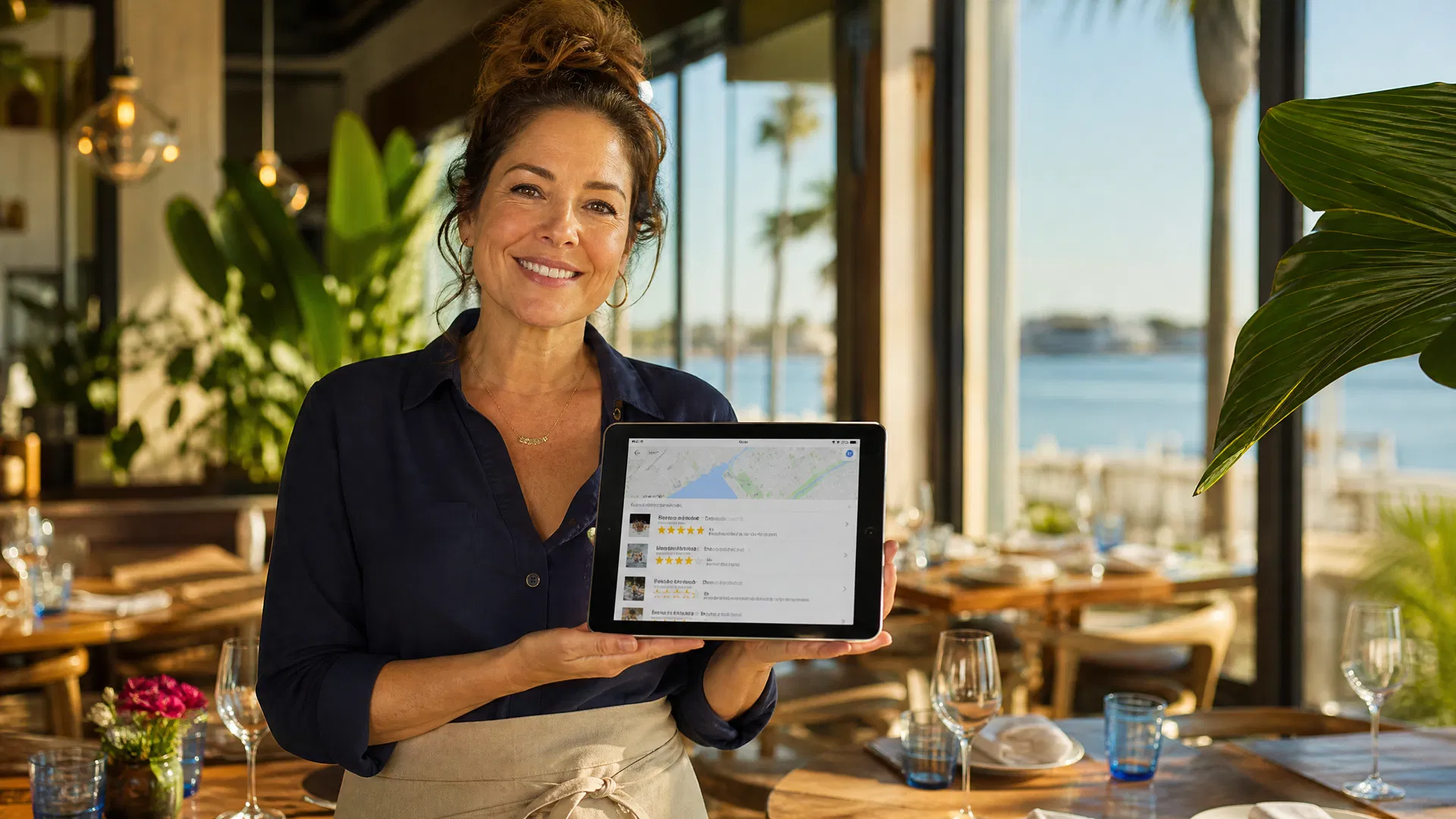
A fully completed Google Business Profile does more for a Sarasota restaurant's visibility than almost any other digital investment. Businesses with photos on their profile receive 42 percent more requests for driving directions and 35 percent more website clicks than those without. Ninety percent of people say they are more likely to visit a business that has photos on Google Search and Maps. For a restaurant, that means high-quality images of your food, your dining room, your bar, your exterior, and your team are not optional extras. They are the first impression.
Start with your primary category. If you are a seafood restaurant, your primary category should be 'Seafood Restaurant,' not just 'Restaurant.' Google allows up to ten categories, and selecting the most specific available primary category is the single highest-leverage optimization action on the entire profile. Add secondary categories that reflect your actual offerings: 'Bar,' 'Waterfront Restaurant,' 'Brunch Restaurant,' or whatever genuinely applies. Categories tell Google exactly what searches to show you for.
Beyond categories, fill in every available field. Add your menu directly to the profile using the menu link or Google's built-in menu editor. Set your hours accurately, including holiday hours and seasonal changes. Enable the reservation link if you use OpenTable, Resy, or a similar platform. Add your website URL. Turn on messaging so customers can reach you directly from the map listing. Each completed field increases your profile's relevance score and gives potential diners more reasons to choose you over the restaurant two listings below.
Reviews: The Ranking Signal Sarasota Restaurants Underestimate
Google's local ranking algorithm weighs review signals heavily: the volume of reviews you have, how recent they are, how frequently new ones arrive, and whether you respond to them. A restaurant with 200 reviews and an owner who responds to every one will consistently outrank a competitor with 80 reviews and no responses, even if the food quality is comparable. Review recency matters as much as volume. A profile that received 150 reviews two years ago and has gone quiet since is less competitive than one that receives five to ten new reviews each month.
Sarasota's restaurant market is one of the most competitive dining environments in Southwest Florida, with hundreds of options competing for the same local and tourist searches. Restaurants that respond to every Google review, maintain a rating above 4.3 stars, and collect new reviews consistently hold a measurable advantage in Google Maps rankings over those that treat reviews as a passive byproduct of service.
The most effective review strategy for a Sarasota restaurant is simple: ask every satisfied guest before they leave. Train your servers to mention it naturally at the end of the meal. Print a small card with a QR code that links directly to your Google review page and place it with the check. Put the same QR code on your receipts and near the exit. The restaurants that consistently rank in the top three on Google Maps for 'restaurants near me' in Sarasota are not there by accident. They have a system for collecting reviews, and they use it every shift.
Respond to reviews when a helpful reply is appropriate, especially when a concern needs acknowledgment. Google publishes no 24-to-48-hour response requirement or direct ranking benefit for every reply.
Instagram and Facebook: Turning Scrollers into Diners
Social media usage as a restaurant marketing strategy jumped from 59 percent to 70 percent among operators between 2024 and 2025. The restaurants driving that shift are not running elaborate campaigns. They are posting consistently, showing real food and real people, and using short-form video to give potential customers a reason to walk in. Instagram Reels now account for 46 percent of all time spent on the platform in the United States, and Reels consistently reach more non-followers than static photos or carousels. For a Sarasota restaurant trying to reach tourists and new residents who do not yet know you exist, Reels are the most efficient organic reach tool available.
The content formula that works for restaurants is not complicated. Show the food being prepared, plated, and delivered. Show the dining room at its best: a full Saturday night, a quiet weekday lunch, a sunset view from your patio. Introduce your team. Highlight seasonal specials and limited-time dishes. Post behind-the-scenes moments from the kitchen. None of this requires a professional videographer. A smartphone held steady, good natural light, and a genuine moment will outperform a polished production every time on Instagram. Authenticity drives engagement, and engagement drives reach.
Post three to four times per week on both Instagram and Facebook. Consistency matters more than volume. A restaurant that posts twice a week every week will build a larger, more engaged audience than one that posts ten times in a burst and then goes quiet for three weeks. Use Instagram Stories daily for lower-effort content: today's specials, a quick kitchen clip, a poll asking followers which dish they want to see next week. Stories keep your profile active in followers' feeds without requiring the same production effort as a main feed post.
Connecting Google and Social: The Strategy Most Sarasota Restaurants Miss
Google and social media can support the same customer journey. A diner may encounter a social post, then verify hours, menu, photos, reviews, location, and reservations in Google. Keep facts consistent and track how campaigns affect reservations, calls, directions, orders, and revenue.
A customer may also discover the restaurant in Maps and then review its website or social channels for atmosphere and current offerings. Update channels when there is useful information, but do not treat inactivity for a fixed number of weeks as proof the restaurant looks closed.
Sarasota's dining market has two distinct seasonal patterns that should shape your content calendar. From November through April, the snowbird population swells and tourist traffic peaks. This is the time to run promotions, highlight your signature dishes, and push for reviews from the high volume of new guests. From May through October, the local audience becomes your primary customer base. Lean into community content: partnerships with local farms and suppliers, participation in events like Savor Sarasota, and content that speaks directly to Sarasota residents rather than visitors. Communica PRO helps Sarasota businesses with marketing strategy. For more on this topic, see short-form video for local service businesses.
Key Takeaways
- Keep category, hours, menu, reservation or order links, attributes, and photos accurate.
- Ask genuine guests for honest reviews without incentives, gating, pressure, or requested wording.
- Use real food, team, and experience content rather than an arbitrary Reel or posting quota.
- Plan for seasonal audiences while verifying current event and tourism information.
- Track reservations, orders, calls, directions, repeat visits, and revenue instead of followers alone.
Related Resources
How Communica PRO Can Help
Communica PRO can audit your Google Business Profile, local rankings, reviews, citations, website alignment, and conversion tracking, then prioritize the gaps you can influence. Learn more about our Local SEO & Google Business Profile. For connected support, see our website and funnel strategy. Specific rankings, AI citations, and lead outcomes cannot be guaranteed.
Related Communica PRO Guides
Continue with Why Your Google Business Profile Is Not Getting Calls; Why Your Competitor Ranks Higher on Google; How Proximity Affects Sarasota Local Pack Rankings.
Frequently Asked Questions
What should a Sarasota restaurant optimize first?
Correct the category, hours, holiday hours, address, phone, website, reservation and menu links, attributes, and current photos. Accuracy matters more than posting to meet an arbitrary frequency.
How should restaurants request reviews?
Invite guests with genuine experiences to leave honest, optional feedback. Do not offer incentives, pressure guests on the premises, gate unhappy customers, or request specific dishes or staff names.
How often should a restaurant post?
There is no universal cadence. Publish when there is useful, accurate content such as current dishes, events, hours, or behind-the-scenes material, then measure reservations and other business outcomes.
Which metrics matter most?
Track reservations, calls, directions, menu views, online orders, qualified website actions, repeat visits, and revenue tied to campaigns rather than followers alone.
Ready to Get More Sarasota Diners Through Your Door?
Communica PRO can audit your Google Business Profile, local rankings, reviews, citations, website alignment, and conversion tracking, then prioritize the gaps you can influence. We will explain the priorities, scope, and measurement plan before you decide how to proceed.