Why “Near Me” Rankings Need Facts, Not Shortcuts
By Marcela Arenas — — Local SEO
What Actually Determines a “Near Me” Result?
Google says local results mainly depend on relevance, distance, and prominence. In plain language: does the business match the request, how far away is it, and how well known is it? Adding a phrase to a page cannot move your business closer to the person searching. Read Google’s explanation of local ranking.
That makes local SEO a process of improving information and usefulness within real geographic limits. Your profile, website, and customer reputation should give people a clear picture of the same business.
Our earlier guide to checking business information in Google’s AI summaries focuses on spotting inaccurate public answers. Here, the question is which local ranking fixes deserve your time and which shortcuts need a second look.
Should You Add “Near Me” Throughout Your Website?
Use language that helps a customer understand the service and location. Repeating “near me” in headings, paragraphs, and lists is not a substitute for that information. Google identifies unnatural keyword repetition intended to manipulate rankings as keyword stuffing. See Google’s spam policies.
A page titled “Plumber Near Me Near Sarasota” tells a visitor less than a clear explanation of the plumbing service, the communities served, and the next step.
Ask whether the wording answers a useful question: Do you handle this problem? Do you serve this area? How does someone arrange service? If the phrase fits naturally, it can appear. It does not need to become the theme of every sentence.
What Business Information Should You Correct First?
Prioritize facts that could send a customer to the wrong place or prevent an inquiry: an old phone number, an outdated address, a different business name, or incorrect hours. These are more useful fixes than spending an afternoon making every abbreviation identical.
NAP means name, address, and phone number. Keep an accurate master record, then compare your website, Google Business Profile, important directories, social profiles, and Chamber of Commerce listing against it.
Google’s guidelines call for a real-world business name and accurate location information. They do not establish that “Suite 200” versus “Ste. 200” automatically creates two businesses or causes a ranking penalty. Review the business representation guidelines.
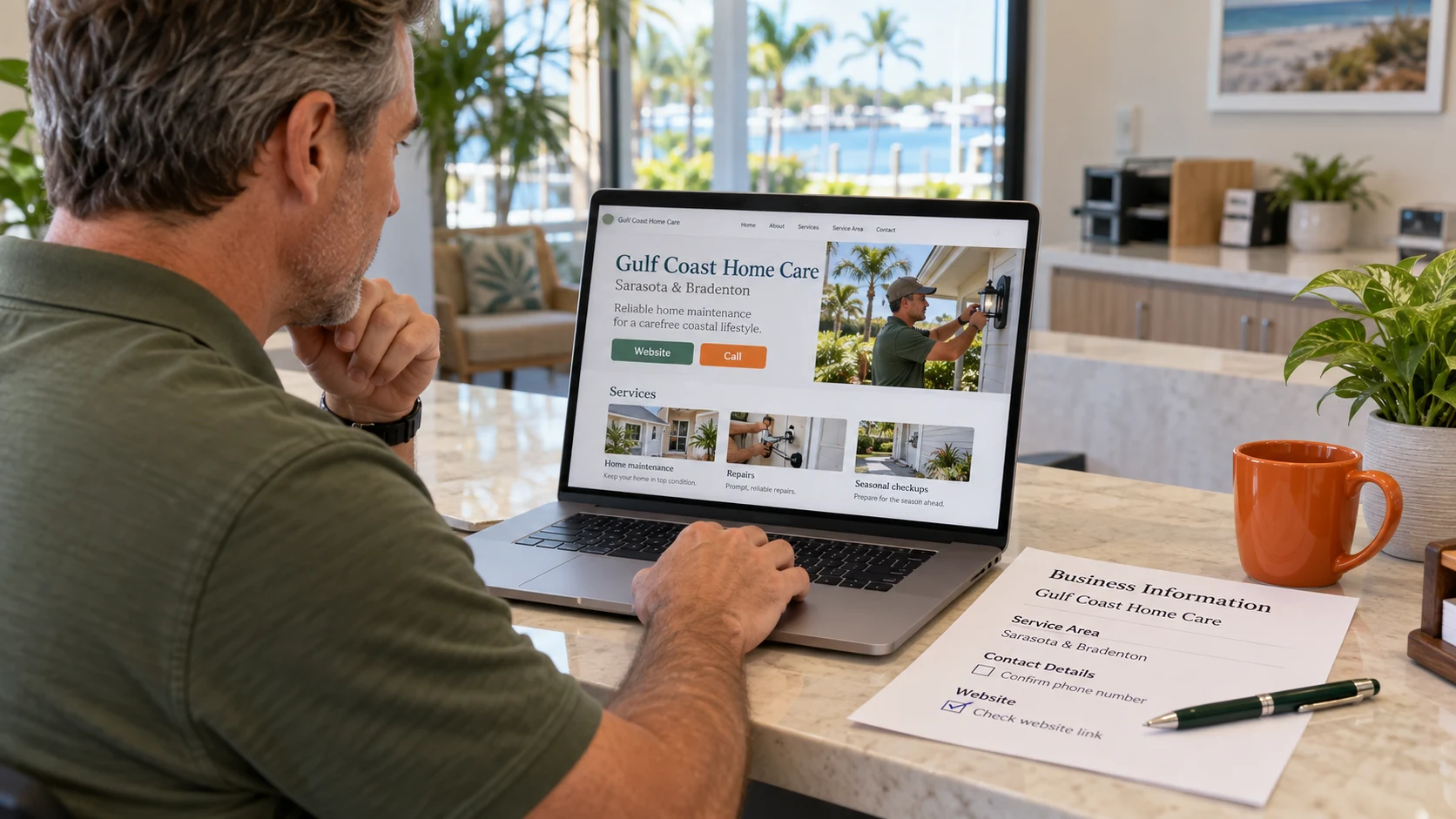
Use the footer to make appropriate contact information easy to find across your website. For a staffed storefront, that can include the public address and a Google Maps link. For a business that visits customers, show clear contact details and the actual service area. Google says service-area businesses should hide their address on the profile when customers do not visit that location. Do not publish a home address merely to complete a local SEO checklist.
A Maps link helps people find the right listing. Treat it as a navigation improvement, rather than a guaranteed ranking boost from a special link format.
What Makes a Google Business Profile Useful?
A useful profile gives someone enough accurate information to understand the business and decide whether to contact it. Review the fields that apply to your operation: categories, services, contact details, hours, description, and location or service area.
Claim the profile and complete Google’s verification process if you have not already done so. Follow Google’s verification guidance.
Check special hours before holidays. Use recent, genuine photos that help customers recognize the premises, understand the work, or meet the team. A mobile service business does not need to invent a storefront, and a service provider does not need to manufacture a product catalog to fill every possible field. Google explains how to update profile information.
The website destination also deserves attention. A single-location business may use its homepage; a business with several locations may use a page representing the relevant location. Google’s guidelines require the destination to represent the actual business location. “Always use the homepage” is too rigid a rule.
Then check the customer experience: does the linked page make calling, booking, or requesting information straightforward? Communica PRO’s Local SEO and Google Business Profile service connects these decisions with the website and customer journey.
Which Directory Listings and Community Links Are Worth Improving?
Start with listings relevant to your customers and industry, then correct missing or outdated business details. A Chamber directory, professional association, or established local resource may be more useful to your audience than a large collection of obscure listings.
Keep a simple record of each listing, its public URL, the information it contains, and who can edit it. Check access before paying someone to create more accounts. Once those facts are accurate, consider what people should remember from each encounter. Our brand recognition guide explains how consistent messaging connects discovery with a later inquiry.
Community relationships can create relevant mentions and links: a genuine association membership, a collaborator’s resource page, or a documented community project. Google identifies links to a business as one consideration in prominence, but it does not publish a universal rule that every local link outweighs every other link.
Start with relationships that already exist. Ask whether a mention helps the organization’s readers understand your role. Do not buy a sponsorship purely for an SEO link or demand ranking-credit links as part of a donation. Google’s spam policies address paid links intended to manipulate rankings; paid links should be marked as sponsored or nofollow by the website publishing them.
Do Reviews Need Photos to Help Your Business?
A review does not need a photo to be useful. An honest account of the customer’s experience can help another person evaluate the service. Google says review quantity and positive ratings can help local ranking, but that does not make a photo compulsory.
Invite customers to share their experience without an incentive or a requirement to praise the business. Google permits review requests and prohibits incentives such as discounts or gifts in exchange for reviews. Read Google’s review guidance.
Do not invite only customers you expect to leave positive reviews or discourage negative feedback. Google prohibits selectively soliciting positive reviews.
A customer may choose to include a relevant photo. Do not promise that embedded location data will improve rankings: Google’s published local-ranking guidance does not establish that mechanism.
Build a repeatable request process as part of normal customer follow-up. Its practical benefit is giving customers a timely opportunity to respond. There is no documented magic review schedule that overrides distance or guarantees a position.
How Can Your Website Show Useful Local Context?
Explain where you genuinely work and what a customer in that area needs to know. Location names should clarify availability, logistics, or the service, rather than decorate generic copy.
A Sarasota service page might explain whether the company handles condominium projects, how it coordinates access, or which communities fall within its normal coverage. Include those details only when they reflect the business’s actual operation.
For a blog, start with a question customers have asked: what should an owner prepare before a service visit, or what approval might a project require? Research any specific building rules or regulatory claims before publishing them. Avoid inventing a local issue to justify a city-specific headline.
Communica PRO’s Sarasota marketing strategy connects this content with the services and customers the business wants to reach.
What Should You Fix Today?
Choose the error most likely to disrupt a real customer’s decision. Then work through the remaining checks in a manageable order:
- **Correct the facts.** Compare your contact information and hours across your website and profile.
- **Clarify the profile.** Confirm verification, then review relevant categories, services, photos, and the website destination.
- **Check important listings.** Correct established directories before expanding the list.
- **Improve review follow-up.** Invite honest feedback, with photos optional.
- **Review real relationships.** Identify useful community mentions without buying ranking promises.
- **Strengthen one service page.** Explain coverage, service details, and the next step.
For a quick win, open your profile and its linked website page side by side. Can a customer tell whether you handle their request, serve their location, and offer a clear way to contact you? Fix the first confusing answer.
Key Takeaways
- “Near me” visibility depends on local relevance, distance, and prominence.
- Fix incorrect business facts before chasing formatting details or special link tricks.
- Complete the profile fields that genuinely apply to your business.
- Genuine reviews and useful local relationships matter without promises about photo geotags or review schedules.
- Clear service pages should connect local interest with a practical next step.
How Can Communica PRO Help You Prioritize the Work?
Communica PRO helps Sarasota and Southwest Florida service businesses connect local visibility, website strategy, and customer follow-up. A Growth Systems Assessment identifies the primary constraint, establishes a measurement baseline, and provides a prioritized roadmap.
**Book an Assessment** when you need to decide which local marketing issue deserves attention first.
**Smart Marketing. Better Systems. Real Growth.**
About the Author
Marcela Arenas, MBA, is the founder and chief strategist of Communica PRO. She leads local SEO, AI visibility, website strategy, and growth systems work for service businesses in Sarasota and Southwest Florida.
Sources
Frequently Asked Questions
Can I Rank for “Near Me” Without Using Those Words?
Yes. Google can identify local intent using the search and available location context. Accurate business information and useful service content matter more than repeating the phrase.
Must Every Address Abbreviation Match Exactly?
Use consistent, accurate information wherever possible. Prioritize incorrect addresses, phone numbers, and business names. Do not assume a harmless abbreviation difference automatically causes a ranking penalty.
Should a Service-Area Business Display Its Home Address?
Google says service-area businesses should hide their address on the profile when customers do not visit it. Describe the actual service area and provide clear contact information. Publishing a home address is not a required local SEO shortcut.
Do Customer Photo Geotags Improve Google Maps Rankings?
Google’s published local-ranking guidance does not establish photo geotags as a ranking factor. Photos can help customers understand a business or experience, but they should not be sold as a location-data ranking trick.
Can These Fixes Guarantee a Top-Three Maps Position?
No. Distance, competition, relevance, and prominence affect results. Evaluate visibility alongside useful inquiries and booked work, rather than expecting a guaranteed position from a checklist.
Prioritize Your Local Visibility Fixes
A Growth Systems Assessment reviews your customer journey, establishes a measurement baseline, and provides a prioritized roadmap.