My Google Ads Are Getting Clicks But No Calls: What's Wrong?
By Marcela Arenas — — Strategy
Why Are My Google Ads Getting Clicks But No Calls?
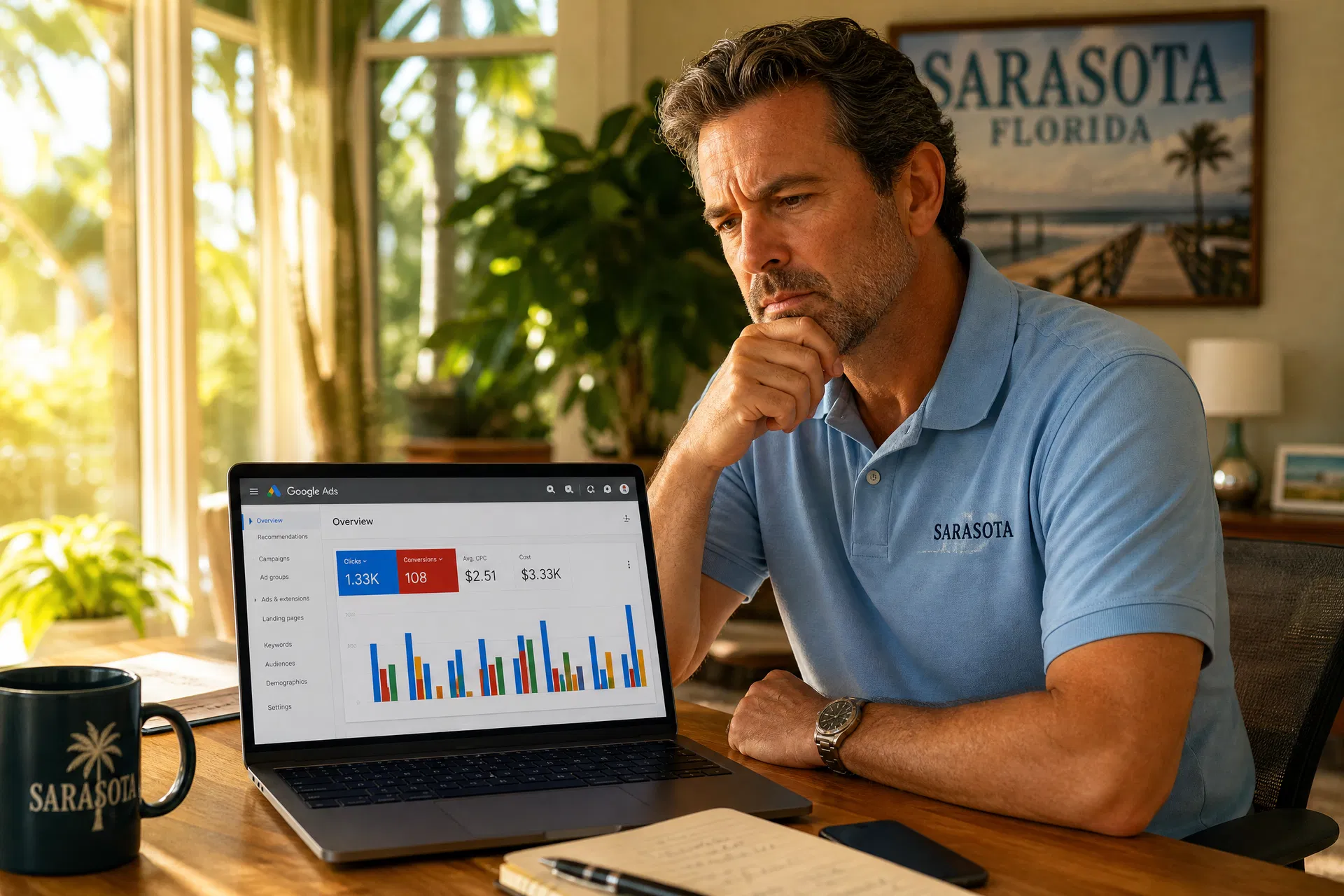
Clicks without calls may mean the campaign reached the wrong searchers, the page did not make the next step clear, calls were not tracked, or the business did not answer or follow up. Industry benchmarks provide context, not a diagnosis for one account.
The good news is that the causes are predictable. After working with service businesses across Sarasota and Southwest Florida, Communica PRO sees the same six problems appear repeatedly. If you have already fixed these and still cannot tell which channel is driving results, read How to Know Which Marketing Is Actually Working. Each one has a clear, actionable fix.
Problem 1: Your Location Targeting Is Pulling In the Wrong People
When you set up a Google Ads campaign, Google defaults your location targeting to 'Presence or interest' rather than 'Presence only.' That single setting means your ads can show to people who are merely searching for or browsing content about your area, not people who are physically located there. This is a common issue that also affects local SEO and Google Maps rankings. A person in Ohio researching Sarasota vacation rentals could trigger your ad for 'AC repair Sarasota' and click on it.
The fix is straightforward. Go to your campaign settings, click on Locations, then click on Location options, and switch from 'Presence or interest' to 'Presence: People in or regularly in your targeted locations.' This one change can immediately reduce wasted spend and improve the quality of traffic reaching your landing page.
Problem 2: Broad Match Keywords Are Attracting the Wrong Searchers
Google's default keyword match type is broad match, which means your ad for 'plumber Sarasota' can appear for searches like 'plumbing school Sarasota,' 'DIY drain fix,' or 'plumber salary Florida.' These searchers are not looking to hire anyone. They click because your ad appeared relevant to their search, but they have no intention of calling.
Two fixes work together here. First, switch your primary keywords to phrase match or exact match to control which searches trigger your ads. Second, build a negative keyword list that excludes terms like 'free,' 'DIY,' 'how to,' 'jobs,' 'salary,' 'training,' and 'school.' Review your Search Terms report weekly for the first month to catch any irrelevant queries that are still slipping through.
Problem 3: Your Ad Is Sending People to Your Homepage
A homepage is designed to introduce your business. A landing page is designed to convert a specific visitor with a specific intent. When someone clicks an ad for 'emergency roof repair Sarasota' and lands on a homepage with six service categories, a blog section, and an about page, they have to do work to find what they were looking for. Most of them will not bother.
Every ad group in your campaign should point to a dedicated landing page that mirrors the ad's message. If the ad says 'Same-Day AC Repair in Sarasota,' the landing page headline should say the same thing. The page should have one clear call to action above the fold, a visible phone number, and nothing else competing for the visitor's attention. This principle is called message match, and it is one of the highest-leverage improvements available to any local service business running paid ads. See our website and funnel strategy guide for a full breakdown of how to structure a conversion-focused page.
Published advertising benchmarks vary by industry, geography, device, campaign type, conversion definition, and period. Compare the account with its own qualified-lead and booked-revenue baseline before using an external average.
Problem 4: Your Landing Page Is Too Slow on Mobile
Mobile speed and usability can affect whether a visitor calls, but no universal three-second abandonment rule predicts one campaign. Review Core Web Vitals, page errors, call-button behavior, and conversion data on actual mobile traffic.
Run your landing page URL through Google's PageSpeed Insights tool (free at pagespeed.web.dev). Look at your mobile score specifically, not just desktop. Common culprits for slow mobile load times include uncompressed images, too many third-party scripts, and hosting that is not optimized for speed. If your page scores below 70 on mobile, fixing speed alone can meaningfully increase your call volume without changing a single word of your ad copy. For a deeper look at what affects load times in 2026, read Website Optimization 2026: Speed, UX and Conversion Trends.
Problem 5: Your Phone Number Is Not Visible Above the Fold on Mobile
This is the simplest problem on this list and one of the most common. A visitor lands on your page, they are ready to call, and they have to scroll to find your phone number. On mobile, 'above the fold' means what is visible without scrolling on a standard smartphone screen. If your phone number is buried in the footer, or only appears in a contact form section halfway down the page, you are creating friction at the exact moment someone is ready to convert.
Your phone number should appear in the header of your landing page as a tappable link, formatted as a tel: link so that tapping it immediately opens the dialer. It should also appear as a large, prominent button in the hero section of the page. For service businesses in Sarasota and Southwest Florida where many customers are making urgent decisions, removing that friction directly translates to more calls. If your Google Business Profile also is not generating calls, read Why Isn't My Google Business Profile Getting Calls?.
Problem 6: Your Conversion Tracking Is Broken
Before assuming your campaign is not generating calls, verify that your tracking is actually recording them. It is possible that calls are happening but are not being attributed to your Google Ads campaign. This occurs when call tracking is set up incorrectly, when the Google Ads conversion tag fires on the wrong page, or when phone calls are not configured as a conversion action at all.
In your Google Ads account, go to Tools, then Conversions, and check that phone calls are listed as an active conversion action. If you are using a call tracking number on your landing page, confirm that it is dynamically swapping for visitors who arrive from Google Ads. If you see clicks in your campaign but zero conversions recorded over a period of two or more weeks, treat broken tracking as the first thing to investigate, not the last. For a broader framework on connecting your data across channels, see How to Know Which Marketing Is Actually Working.
Key Takeaways
- Confirm conversion tracking and call reporting before judging performance.
- Review search terms, locations, devices, hours, and match types for qualified intent.
- Match each ad to a focused, accurate landing page with a visible mobile next step.
- Measure qualified calls, booked work, revenue, and profit, not clicks alone.
- Use sufficient data and controlled changes rather than universal benchmark targets.
Why are my Google Ads getting clicks but no calls or leads?
The most common reasons are wrong location targeting, broad match keywords pulling in irrelevant searchers, a landing page that sends traffic to your homepage instead of a dedicated conversion page, slow mobile load speed, a phone number that is not visible above the fold, or broken call tracking. Each issue has a specific fix and most can be resolved within a single campaign audit session.
What is a good conversion rate for Google Ads for local service businesses?
According to LocaliQ's 2025 Home Services Search Ads Benchmarks, the average conversion rate for home services is 7.33%. Plumbing averages 7.63% and electricians average 9.08%. If your campaign is generating clicks but near-zero conversions, something structural is broken rather than simply underperforming.
What is message match and why does it matter for Google Ads?
Message match means the headline and offer on your landing page directly mirrors the language in the ad that brought the visitor there. If your ad says 'Emergency Plumber Sarasota' but your landing page headline is generic, visitors feel a disconnect and leave. Strong message match is one of the highest-leverage improvements for local service businesses running paid ads.
How do negative keywords help Google Ads performance for local businesses?
Negative keywords prevent your ads from showing for searches that are unlikely to convert, such as 'DIY drain fix,' 'plumber salary,' or 'how to install AC.' Without a negative keyword list, broad match campaigns regularly waste budget on job seekers, students, and DIY researchers who have no intent to hire. Reviewing your Search Terms report weekly and adding negatives is one of the fastest ways to improve cost per lead.
How does page speed affect Google Ads conversion rates?
Pages that load in one second have three times higher conversion rates than pages that take five seconds, according to Google data. Most local service searches happen on mobile, where slow load times cause visitors to abandon the page before it finishes rendering. Running your landing page through Google's PageSpeed Insights and fixing the top mobile issues can increase call volume without changing your ad copy or budget.
How can Communica PRO help Sarasota businesses improve their Google Ads results?
Communica PRO audits Google Ads campaigns for Sarasota and Southwest Florida service businesses, identifying the specific issues causing clicks without conversions. This includes reviewing location targeting, keyword match types, landing page quality, message match, mobile speed, and conversion tracking setup. Book a free strategy call to get a diagnosis of your current campaign.
Sources
How Communica PRO Can Help
Communica PRO can trace paid clicks through the landing page, call and form tracking, response process, and sales handoff to find where qualified demand is being lost. Learn more about our Lead Generation or use the consultation link below to discuss your priorities. Recommendations are based on your current data, market, and goals; specific rankings, AI citations, and lead outcomes cannot be guaranteed. For connected support, see our website and funnel strategy.
Related Communica PRO Guides
Continue with Sarasota Landing Page; Website Lead Gen Sarasota; Marketing Attribution Sarasota.
Frequently Asked Questions
Why are my Google Ads getting clicks but no calls or leads?
The most common reasons are wrong location targeting, broad match keywords pulling in irrelevant searchers, a landing page that sends traffic to your homepage instead of a dedicated conversion page, slow mobile load speed, a phone number that is not visible above the fold, or broken call tracking. Each issue has a specific fix and most can be resolved within a single campaign audit session.
What is a good conversion rate for Google Ads for local service businesses?
According to LocaliQ's 2025 Home Services Search Ads Benchmarks, the average conversion rate for home services is 7.33%. Plumbing averages 7.63% and electricians average 9.08%. If your campaign is generating clicks but near-zero conversions, something structural is broken rather than simply underperforming.
What is message match and why does it matter for Google Ads?
Message match means the headline and offer on your landing page directly mirrors the language in the ad that brought the visitor there. If your ad says 'Emergency Plumber Sarasota' but your landing page headline is generic, visitors feel a disconnect and leave. Strong message match is one of the highest-leverage improvements for local service businesses running paid ads.
How do negative keywords help Google Ads performance for local businesses?
Negative keywords prevent your ads from showing for searches that are unlikely to convert, such as 'DIY drain fix,' 'plumber salary,' or 'how to install AC.' Without a negative keyword list, broad match campaigns regularly waste budget on job seekers, students, and DIY researchers who have no intent to hire. Reviewing your Search Terms report weekly and adding negatives is one of the fastest ways to improve cost per lead.
How does page speed affect Google Ads conversion rates?
Pages that load in one second have three times higher conversion rates than pages that take five seconds, according to Google data. Most local service searches happen on mobile, where slow load times cause visitors to abandon the page before it finishes rendering. Running your landing page through Google's PageSpeed Insights and fixing the top mobile issues can increase call volume without changing your ad copy or budget.
How can Communica PRO help Sarasota businesses improve their Google Ads results?
Communica PRO audits Google Ads campaigns for Sarasota and Southwest Florida service businesses, identifying the specific issues causing clicks without conversions. This includes reviewing location targeting, keyword match types, landing page quality, message match, mobile speed, and conversion tracking setup. Book a free strategy call to get a diagnosis of your current campaign.
Getting Clicks But Not Enough Calls From Your Sarasota Google Ads?
Communica PRO can trace paid clicks through the landing page, call and form tracking, response process, and sales handoff to find where qualified demand is being lost. We will explain the recommended priorities, scope, and measurement plan before you decide how to proceed.