
What Do AI Visibility Tools Actually Measure?
AI visibility tools usually run or analyze a selected set of prompts. A prompt is the question or instruction used to generate an answer. A report may evaluate whether the business appeared, how it was described, which competitors appeared, and which websites were referenced.
Those observations are useful, but they are limited to the prompts, platforms, settings, and reporting period included in the report. They should not be presented as a census of everything an AI platform says about a business.
AI monitoring tools examine a sample of questions and answers. Their scores are not a complete measure of market visibility.
A business mention, a website citation, a referral visit, and a qualified inquiry are different events.
Search Console, Google Analytics, a CRM, and third-party monitoring tools each answer different questions.
Keep questions, platforms, locations, and reporting periods consistent enough to make comparisons.
The best tool helps a business make better decisions, not simply produce a higher score.
Why Should a Local Business Measure AI Visibility?
A Sarasota homeowner might ask an AI assistant to compare pool maintenance companies. A Lakewood Ranch business owner might ask which marketing agencies help service businesses improve lead follow-up. In both cases, the customer may see business names, summaries, or links before visiting a website.
The answer may change with the wording, location, platform, and available information. Monitoring offers a starting point for checking whether services are described accurately, identifying missing information, and deciding what to review. It does not reveal every customer conversation.
What Is the Difference Between a Mention, Citation, Visit, and Inquiry?
A mention is not the same as a citation
A brand mention means the business name appears in an answer. It may or may not include a link. A website citation or source link references a page as supporting information. That page might belong to the business, a news outlet, a directory, or another organization.
Both can matter. A business could be mentioned without its website being linked, while a website might be cited without the business being recommended as a provider.
A referral visit is not the same as a customer
A referral visit occurs when someone clicks through to a website and analytics records the source. A person can read an answer without clicking or return later through a different channel. A qualified inquiry is a potential customer who fits the business’s services and basic requirements. A visit or form submission does not automatically establish that fit.
For a closer look at referral reporting, see How to Track ChatGPT Referral Traffic and Leads in GA4.
Which Tools Answer Which Questions?
A strong measurement setup does not depend on one dashboard. AI visibility monitoring tools can report on selected prompts and sources. Search Console can show eligible website impressions in Google Search AI features. Analytics can identify some website visits, while CRM and call records help evaluate inquiries and opportunities.
Choose the right source for each question
| Question | Useful source | What to remember |
|---|---|---|
| Did the business appear in selected AI answers? | AI visibility monitoring tool | Results reflect the tracked prompts, platforms, and settings. |
| Which sites were cited? | Monitoring report with sources | A cited website is not necessarily a recommended business. |
| Were website pages shown in Google AI features? | Search Console generative AI report | It measures eligible Google Search AI impressions. |
| Did someone visit the website? | Google Analytics 4 | Referral information may be incomplete. |
| Did the visit become a suitable opportunity? | CRM and call records | A qualified inquiry and a sale are different outcomes. |
BrightLocal and Ubersuggest
BrightLocal’s Local AI Visibility reports can show metrics for tracked prompts, platforms, competitors, and cited sources. Its documentation describes measures such as mention rate and share of voice. BrightLocal explains its reporting here.
Ubersuggest also offers AI search visibility reporting, including brand visibility and tracked prompt analysis. Ubersuggest describes its AI visibility tools. Available features and coverage should be checked against the plan and the business’s reporting needs.
Before subscribing, ask which platforms are covered, how prompts are selected, whether local context can be specified, how often reports update, and whether the team can inspect the underlying answers. Features and pricing can change. Our guide to keyword tracking tools explains how to judge whether another reporting subscription supports a useful decision.
Google Search Console
Google’s generative AI performance report provides a dedicated view of website impressions in supported Google Search AI features, including AI Overviews and AI Mode. Google says this activity is also included in the overall Search performance report. A property may not show the dedicated report if it has not received enough eligible impressions. Google explains the report and its limits.
This report helps owners understand website-page visibility in Google’s AI features. It does not measure every business mention in ChatGPT, Perplexity, or other AI products.
Google Analytics and the CRM
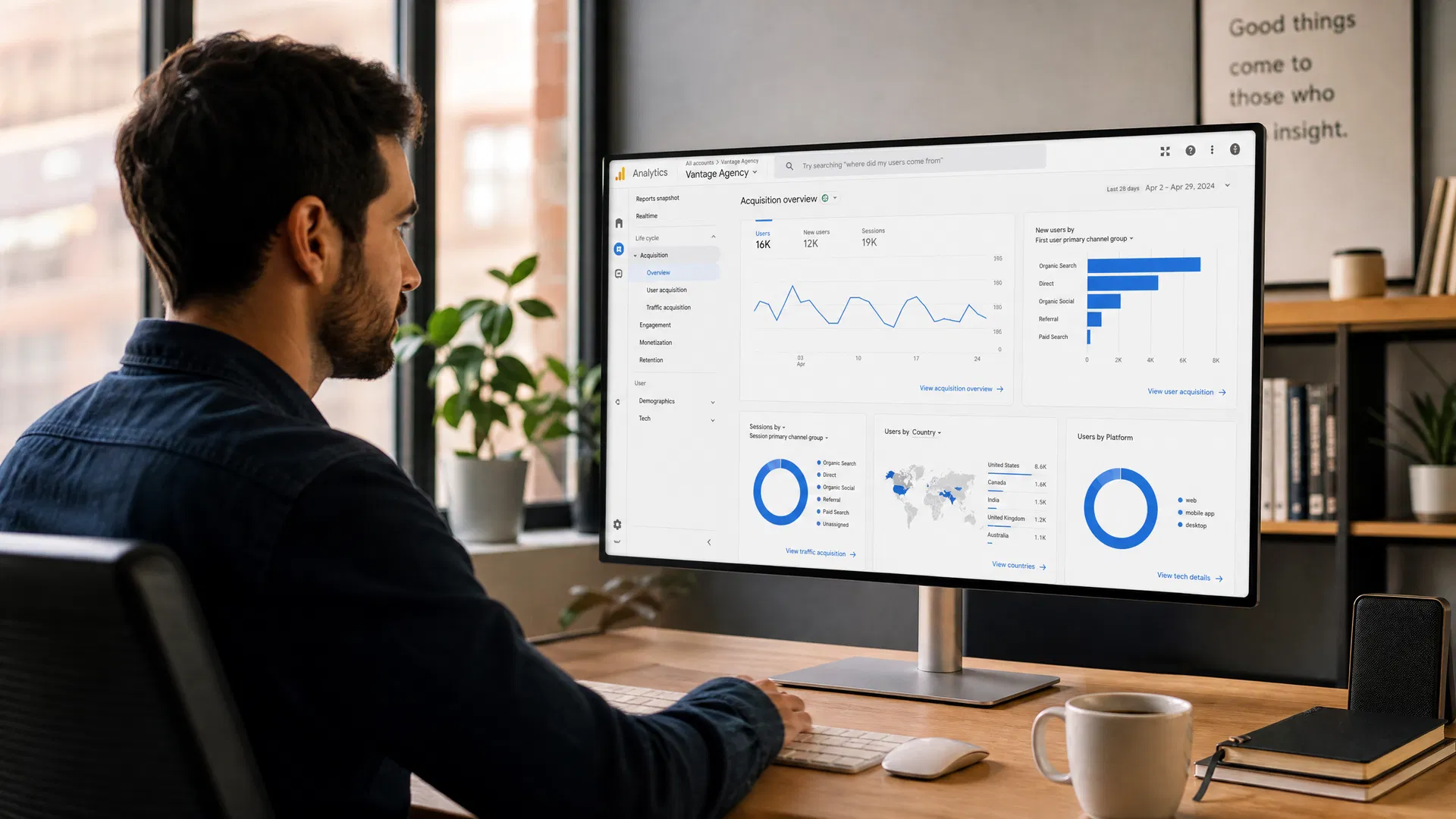
Google Analytics 4 can help identify traffic sources when referral information is retained. Its Traffic acquisition report includes a Session source / medium dimension and can show relevant key events. Google’s Traffic acquisition documentation explains the report. Consent settings, browsers, blockers, redirects, and referrer handling can make attribution incomplete.
A CRM adds context: whether an inquiry was relevant, whether the team responded, and whether an opportunity progressed. Where appropriate, a simple question asking how someone heard about the business can add context, though self-reported answers may be incomplete. A report showing mentions but no identifiable visits can still help with accuracy; it does not by itself demonstrate a return on investment.
How Should a Business Choose Questions to Track?
Start with questions a prospective customer might ask before choosing a provider. Include discovery, comparison, and branded questions. For a Sarasota-area service business, a starting set might include:
- Service discovery: “Which companies offer pool maintenance in Sarasota?”
- Specific need: “Who provides recurring pool service for a home in Lakewood Ranch?”
- Comparison: “What should I compare when choosing a pool service company in Bradenton?”
- Branded accuracy: Ask what services your business provides.
- Service area: Ask whether your business serves a specific city.
Replace the examples with the actual services and communities the company serves. Branded questions check whether the business is described accurately. Unbranded questions examine whether it appears when a customer does not already know its name. BrightLocal explains the distinction.
Keep a core set of questions stable for comparisons. When adding or changing prompts, record the change so a score movement is not mistaken for a change in visibility.
Why Might Two AI Visibility Tools Report Different Scores?
Tools may use different prompts, platforms, locations, schedules, sampling methods, competitor sets, or scoring formulas. Even when questions are similar, answers can vary. Read the methodology before treating two numbers as comparable.
For example, a tool might report that a business appeared in three of ten tracked answers. That is a 30% mention rate for that sample. It does not mean that 30% of all customers asking similar questions will see the business.
Share of voice is different again. A tool may calculate it from the business’s share of mentions among businesses in its tracked answers. Check the vendor’s definition and denominator, then inspect the underlying prompts, sources, and factual accuracy before deciding what changed.
What Should You Do When a Report Finds a Gap?
A missing mention is a reason to investigate. It is not proof that one missing directory listing or website paragraph caused the result. Start with evidence you can verify:
- Check whether the question matches a real service and location.
- Read the answer and note whether the business was omitted or described inaccurately.
- Review cited sources for useful context and factual inconsistencies.
- Inspect the relevant service page for clear services, audience, service area, and next steps.
- Look for genuine independent evidence, such as relevant professional profiles, reviews, or local coverage.
- Record the change and retest using the same core prompts, allowing for normal variation.
Google says established search fundamentals remain relevant for its AI features, including accessible pages, useful content, and accurate business information. Eligibility does not guarantee that a page will be selected. Read Google’s AI features guidance and the Lakewood Ranch digital footprint audit for practical checks.
A Simple Monthly AI Visibility Worksheet
A spreadsheet is enough to begin. Give each important question its own row and record the date, platform, exact prompt, stated location, whether the business appeared, any factual errors, cited sources, relevant competitors, follow-up action, owner, and review date.
Monthly AI visibility worksheet
| Field | What to record |
|---|---|
| Date and platform | When and where the question was tested |
| Exact question | The prompt and stated city or service |
| Business mentioned? | Yes or no, based on the observed answer |
| Description accurate? | Note missing or incorrect facts |
| Sources shown | Website pages and other sources cited |
| Relevant competitors | Businesses mentioned in the same answer |
| Follow-up action | A specific fact, page, or profile to review |
| Owner and review date | Who will check the issue and when |
Keep a separate monthly summary for identifiable referral visits and qualified inquiries. Exclude test submissions from real lead totals. Over time, the worksheet can show whether important facts are becoming more consistent and whether the business appears more often in the questions it tracks. Small samples still require caution.
How Can Communica PRO Help?
Communica PRO helps Sarasota and Southwest Florida service businesses assess AI visibility alongside local search, website content, and lead measurement. The work starts with the business’s services and customer questions, then examines the public information and website pages that support those answers.
Explore AI visibility and GEO services or learn how a Sarasota marketing agency can connect visibility, customer inquiries, and follow-up.
Start With a Better Question
An AI visibility report is most valuable when it leads to a useful decision: correcting an inaccurate service description, improving a relevant page, or checking whether inquiries are recorded correctly. Choose representative customer questions, understand what each report measures, and connect the findings to real business outcomes.
Primary Sources and Related Resources
Frequently Asked Questions
01Are AI visibility tools necessary for every small business?
No. A business can start by manually testing a few relevant questions and recording the answers. A monitoring tool becomes more useful when the team needs to track more prompts, platforms, competitors, or locations consistently.
02Can Search Console show AI visibility?
Search Console can report eligible website impressions in supported Google Search generative AI features. It does not provide a complete picture of mentions across other AI products.
03Does a high AI visibility score mean more customers?
Not necessarily. A score describes what a tool observed in its tracked sample. Compare visibility with relevant visits, qualified inquiries, and CRM outcomes before evaluating business impact.
04Why does my business appear for one question but not another?
Answers can vary with wording, location, platform, available sources, and other context. Compare a consistent group of relevant prompts over time instead of relying on one answer.
05How often should I check AI visibility?
A monthly review is a practical starting point for many small businesses. A team making substantial website or profile changes may review observations more frequently, while allowing enough time and data to assess a pattern.